What Causes the Northern Lights? The Solar Science Explained
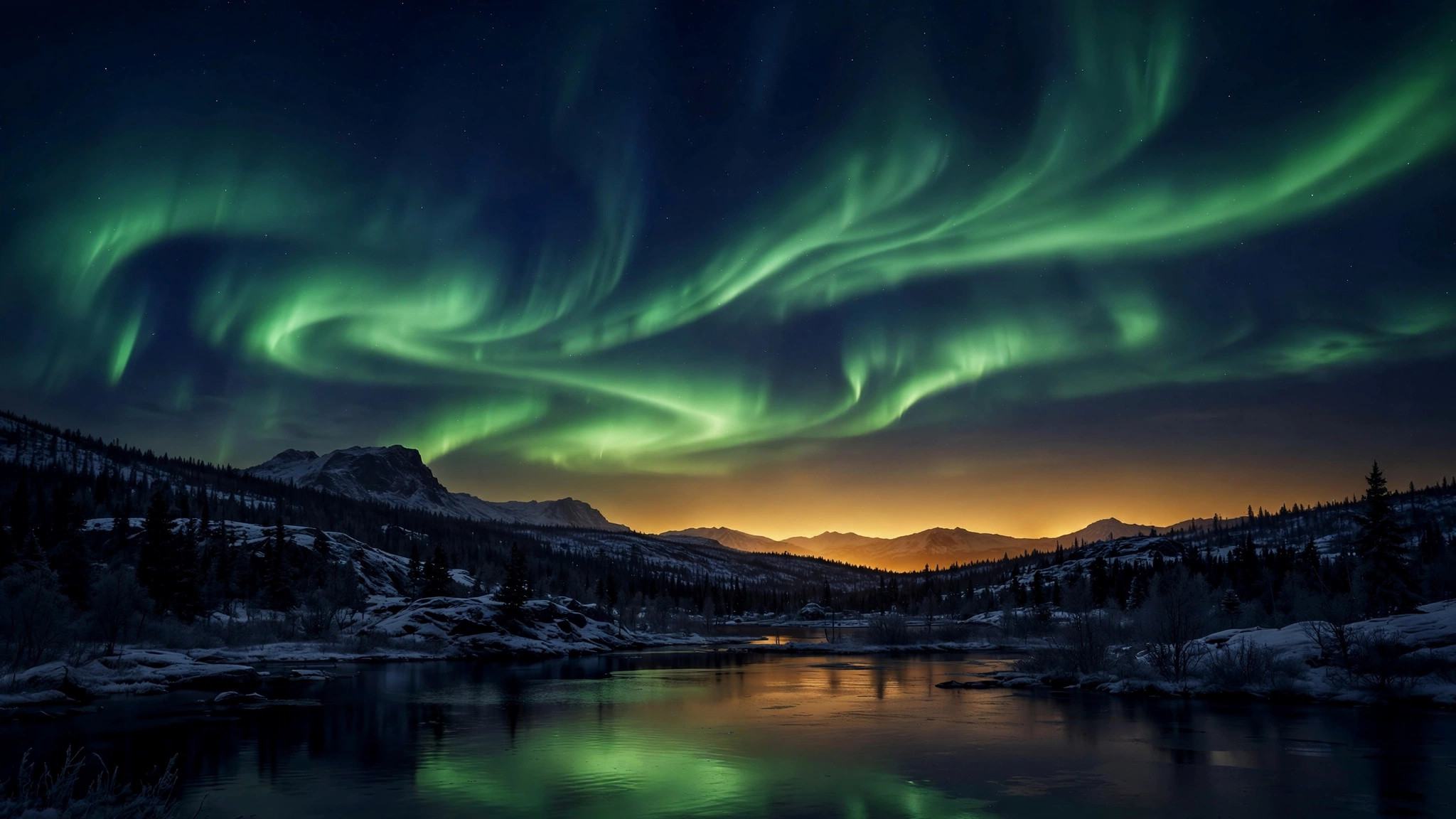
The northern lights start on the Sun, 150 million kilometres away. Here is the journey those particles take before the sky turns green.
What causes the northern lights? The short answer starts far from Earth. The Sun constantly streams charged particles outwards, and when that stream — or a bigger burst from a solar flare or coronal mass ejection — reaches our planet, some of the energy ends up lighting the sky near the poles.
That display, the aurora borealis in the north and the aurora australis in the south, is one of nature's largest shows. It is also a visible sign that Earth's magnetic shield is doing its job.
What causes the northern lights to appear near the poles?
Earth's magnetic field deflects most of the solar wind, but it also funnels some charged particles down towards the polar regions, following magnetic field lines. High in the atmosphere, those fast-moving particles collide with gases such as oxygen and nitrogen.
A collision gives an atom extra energy. When the atom settles back down, it releases that energy as light. Billions of these tiny flashes, happening together across a wide region, become the curtains and ribbons we see from the ground. NASA describes auroras as the result of energy stored in Earth's magnetic environment being released into the atmosphere.
Why are the lights green, red and purple?
The colour depends on which gas is struck and at what height. According to NASA, oxygen produces green light at roughly 100 to 200 kilometres up, and red light above about 200 kilometres. Nitrogen in a similar height range can glow blue, and lower down it can add pink or reddish-purple edges.
Green is therefore the colour people see most often: it comes from oxygen in the height range where displays are strongest, and our eyes are especially sensitive to green. Red auroras are rarer and usually appear during stronger geomagnetic storms. When a storm is powerful enough, the auroral zone expands away from the poles, and people much further south in the United States can sometimes see the lights — usually as a faint red or green glow low in the northern sky.
When can you see them?
You need darkness, clear skies and patience. Auroras can happen at any time of year, but long winter nights near the Arctic give the best odds. Forecasters at NOAA's Space Weather Prediction Center track solar activity and issue aurora forecasts, because a display often follows a solar eruption by a day or more.
For another sky effect driven by sunlight and geometry, read why a day on Venus is longer than its year, or how scientists measure the Moon drifting slowly away from Earth.
Next time the northern sky shimmers green, remember what you are watching: sunlight, in particle form, meeting Earth's shield — and losing, beautifully.
Questions, answered
What causes the northern lights to appear near the poles?
Earth's magnetic field deflects most of the solar wind, but it also funnels some charged particles down towards the polar regions, following magnetic field lines. High in the atmosphere, those fast-moving particles collide with gases such as oxygen and nitrogen.
Why are the lights green, red and purple?
The colour depends on which gas is struck and at what height. According to NASA, oxygen produces green light at roughly 100 to 200 kilometres up, and red light above about 200 kilometres. Nitrogen in a similar height range can glow blue, and lower down it can add pink or reddish-purple edges.
When can you see them?
You need darkness, clear skies and patience. Auroras can happen at any time of year, but long winter nights near the Arctic give the best odds. Forecasters at NOAA's Space Weather Prediction Center track solar activity and issue aurora forecasts, because a display often follows a solar eruption by a day or more.
More mind-blowing facts
 Space
Why Does the Moon Look Bigger on the Horizon? The Moon Illusion Explained
Why does the Moon look bigger on the horizon? It does not — photographs prove the disc is the same size. The Moon illusion is your brain misjudging distance, not the Moon changing size.
 Space
Why Is Mars Red? The Rusty Dust That Paints the Red Planet
Why is Mars red? Iron in its rocks oxidised into rust, crumbled into fine dust and was blown across the whole planet — and a 2025 study suggests much of that rusting happened while Mars still had liquid water.
 Space
Why Is Pluto Not a Planet? The Three-Rule Test It Failed
Pluto is not a planet because it fails one of the three rules astronomers set in 2006 — it has not cleared its neighbourhood of other icy bodies in the Kuiper Belt.