Is the Moon Drifting Away from Earth? Yes — 3.8 cm Every Year
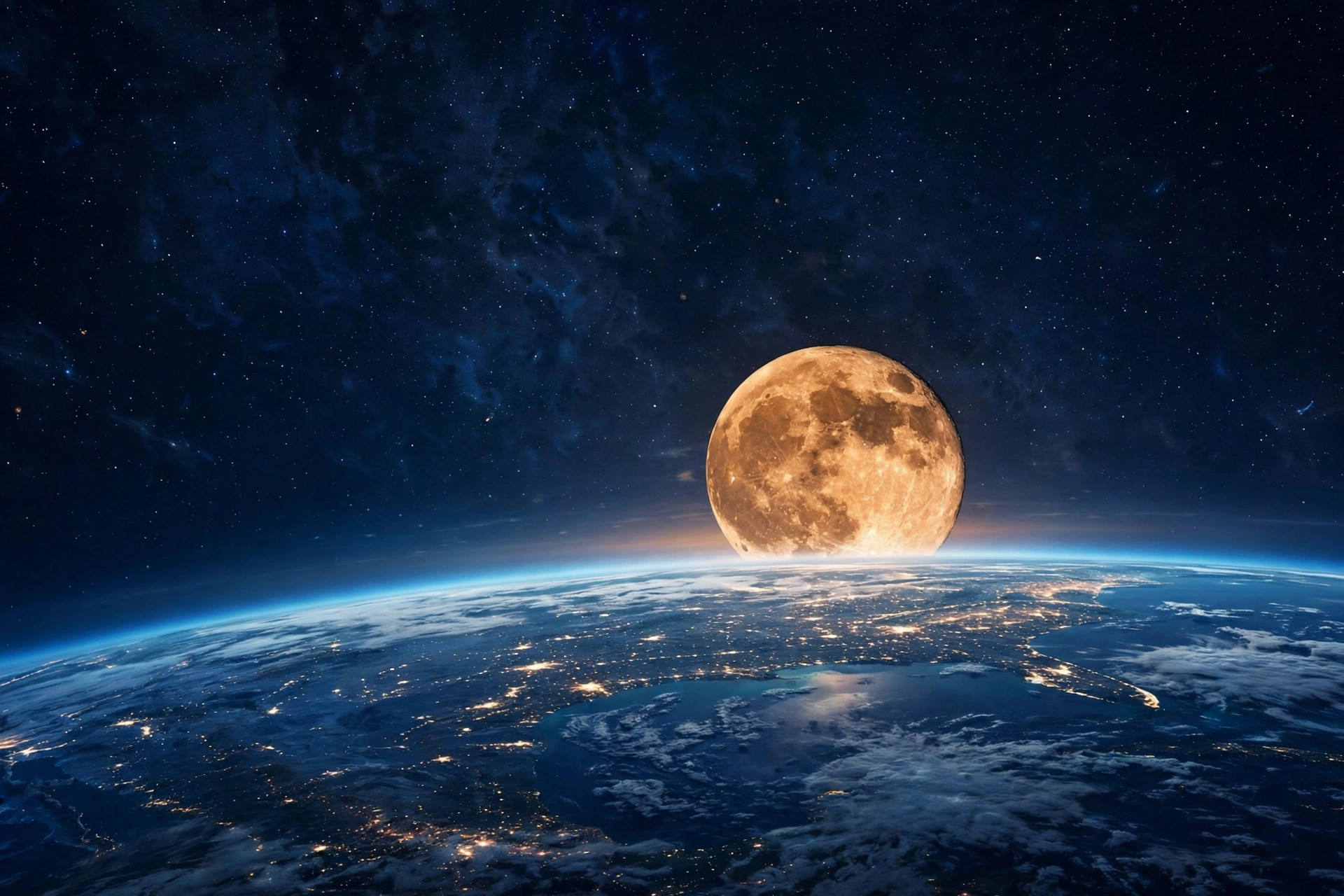
The Moon drifts about 3.8 centimetres further from Earth every year. Apollo-era mirrors let scientists measure it to the millimetre.
The Moon is leaving us — slowly, but measurably. Every year, the average distance between Earth and the Moon grows by about 3.8 centimetres, roughly the speed your fingernails grow. Over a human lifetime, that adds up to around three metres.
How do we know? Mirrors on the Moon
This is not a guess. During the Apollo missions, astronauts left special mirrors called retroreflectors on the lunar surface. Scientists on Earth fire lasers at these mirrors and time how long the light takes to bounce back. Because light travels at a known speed, the round trip gives the distance to within millimetres.
Decades of these measurements — a technique called lunar laser ranging — confirm the drift with extraordinary precision.
Is the Moon moving away from Earth? Why it drifts
The culprit is the tides. The Moon's gravity pulls on Earth's oceans, creating tidal bulges. Because Earth spins faster than the Moon orbits, friction drags those bulges slightly ahead of the Moon. The bulges then gravitationally tug the Moon forward, adding energy to its orbit and pushing it outward — while Earth's own rotation slows down a tiny fraction.
This has been happening for about 4.5 billion years. Billions of years ago, the Moon was much closer and appeared far larger in the sky — and Earth's days were considerably shorter.
Will the Moon ever leave completely?
Not in any timeframe that matters. The drift will continue for billions of years, but long before the Moon could escape, the Sun will have swollen into a red giant and transformed the inner solar system. For now, the Moon remains firmly — if slightly less firmly — ours.
Questions, answered
Will the Moon ever leave completely?
Not in any timeframe that matters. The drift will continue for billions of years, but long before the Moon could escape, the Sun will have swollen into a red giant and transformed the inner solar system. For now, the Moon remains firmly — if slightly less firmly — ours.
More mind-blowing facts
 Space
Why Does the Moon Look Bigger on the Horizon? The Moon Illusion Explained
Why does the Moon look bigger on the horizon? It does not — photographs prove the disc is the same size. The Moon illusion is your brain misjudging distance, not the Moon changing size.
 Space
Why Is Mars Red? The Rusty Dust That Paints the Red Planet
Why is Mars red? Iron in its rocks oxidised into rust, crumbled into fine dust and was blown across the whole planet — and a 2025 study suggests much of that rusting happened while Mars still had liquid water.
 Space
Why Is Pluto Not a Planet? The Three-Rule Test It Failed
Pluto is not a planet because it fails one of the three rules astronomers set in 2006 — it has not cleared its neighbourhood of other icy bodies in the Kuiper Belt.