Why Does the Moon Look Bigger on the Horizon? The Moon Illusion Explained
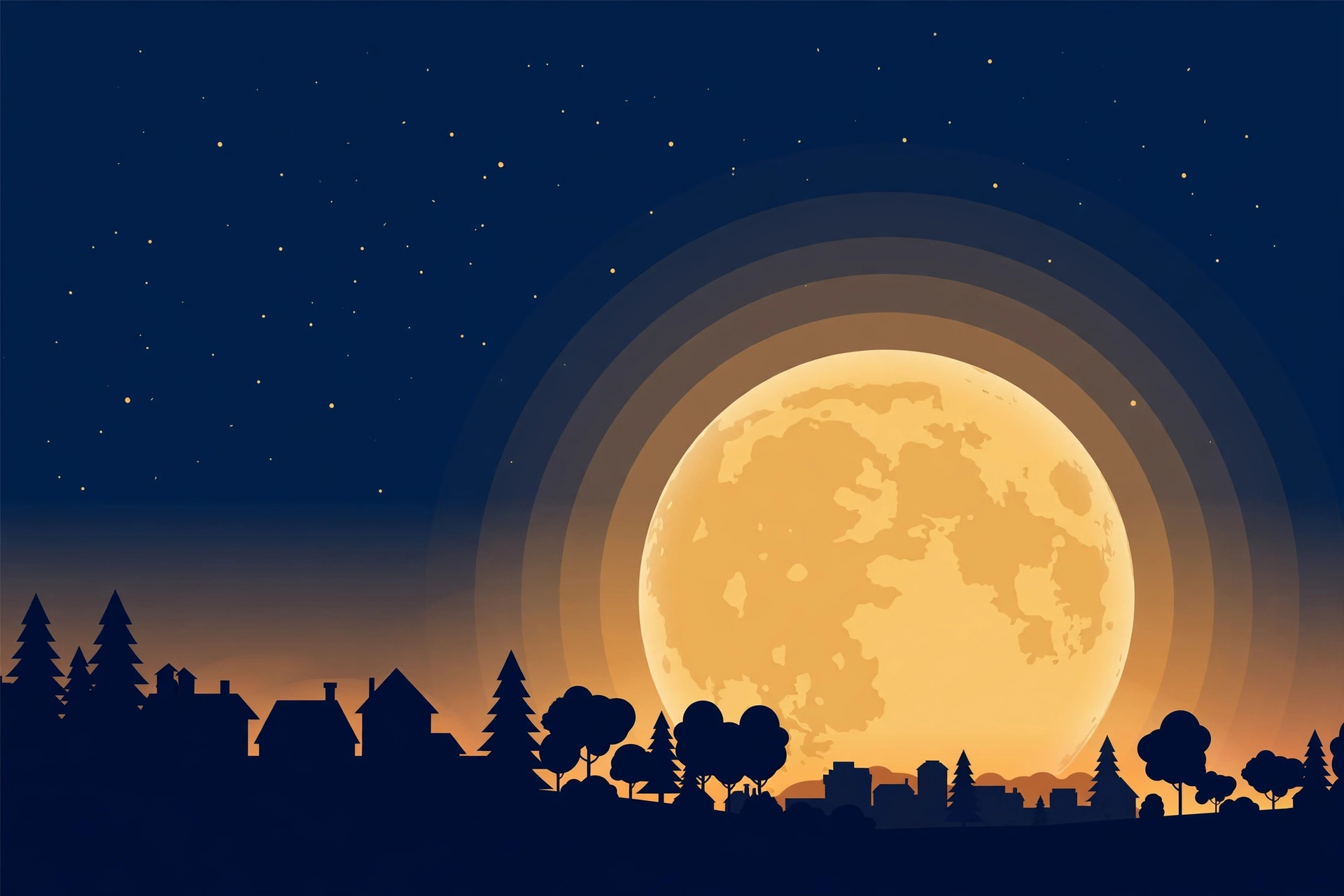
Why does the Moon look bigger on the horizon? It does not — photographs prove the disc is the same size. The Moon illusion is your brain misjudging distance, not the Moon changing size.
Why does the Moon look bigger on the horizon? Stand under a rising full Moon and it can look enormous, filling the sky above the rooftops — yet a few hours later, high overhead, the same Moon looks ordinary. The honest answer is that the Moon does not change size at all. Photograph it low and high with the same zoom setting and the two discs come out the same width. In fact the horizon Moon is about 1.5 per cent smaller, not bigger, because you are one Earth radius — 6,371 kilometres — farther from it than an observer with the Moon directly overhead. What you are seeing is the Moon illusion, a trick of visual processing that has puzzled observers since Aristotle noticed it in the 4th century BCE — and after more than 2,000 years of argument, scientists still have no agreed explanation for it.
The oldest suspect, the Earth's atmosphere, has been cleared. Aristotle's contemporaries guessed that the air magnified the Moon like a lens, but measurements rule that out: the atmosphere changes the Moon's colour, not its size. View the horizon Moon through a cardboard tube that hides the landscape, and the illusion vanishes altogether — the effect depends entirely on the visual cues around the Moon, not on the Moon itself.
Why does the Moon look bigger on the horizon? Your brain misjudges distance
The leading explanation is the apparent-distance theory, first sketched by Ptolemy in the 2nd century and developed by the 11th-century scientist Ibn al-Haytham. We subconsciously perceive the sky not as a hemisphere but as a flattened dome: the horizon feels far away, because the ground between us and it is full of intervening objects, while the sky directly overhead feels close. The Moon's image is the same size on the retina in both positions — but if the brain believes the horizon Moon is much farther away, the only consistent conclusion is that the object must be physically bigger. This is size constancy, the mechanism that stops a person walking towards you from appearing to swell, doing its job on an object it was never calibrated for.
A second explanation works alongside it. The Ponzo illusion, named after Italian psychologist Mario Ponzo, shows that we judge an object's size against the things around it: surrounded by small things, it looks big. High overhead, the Moon is judged against the vast, empty night sky and looks small. Near the horizon, it sits beside trees, houses and hills — objects it dwarfs — and looks huge, typically about 50 per cent wider than it really seems overhead.
The orange colour of a rising Moon is real, though, and it has a different cause. Near the horizon you see the Moon through a much longer path of atmosphere, and the air scatters short blue wavelengths away, leaving the long red and orange ones — the same Rayleigh scattering that makes the sky blue by day and sunsets red.
More mind-blowing facts
 Space
Why Is Mars Red? The Rusty Dust That Paints the Red Planet
Why is Mars red? Iron in its rocks oxidised into rust, crumbled into fine dust and was blown across the whole planet — and a 2025 study suggests much of that rusting happened while Mars still had liquid water.
 Space
Why Is Pluto Not a Planet? The Three-Rule Test It Failed
Pluto is not a planet because it fails one of the three rules astronomers set in 2006 — it has not cleared its neighbourhood of other icy bodies in the Kuiper Belt.
 Space
What Causes the Northern Lights? The Solar Science Explained
The northern lights start on the Sun, 150 million kilometres away. Here is the journey those particles take before the sky turns green.