Why Do Onions Make You Cry? The Tear Gas in Your Kitchen
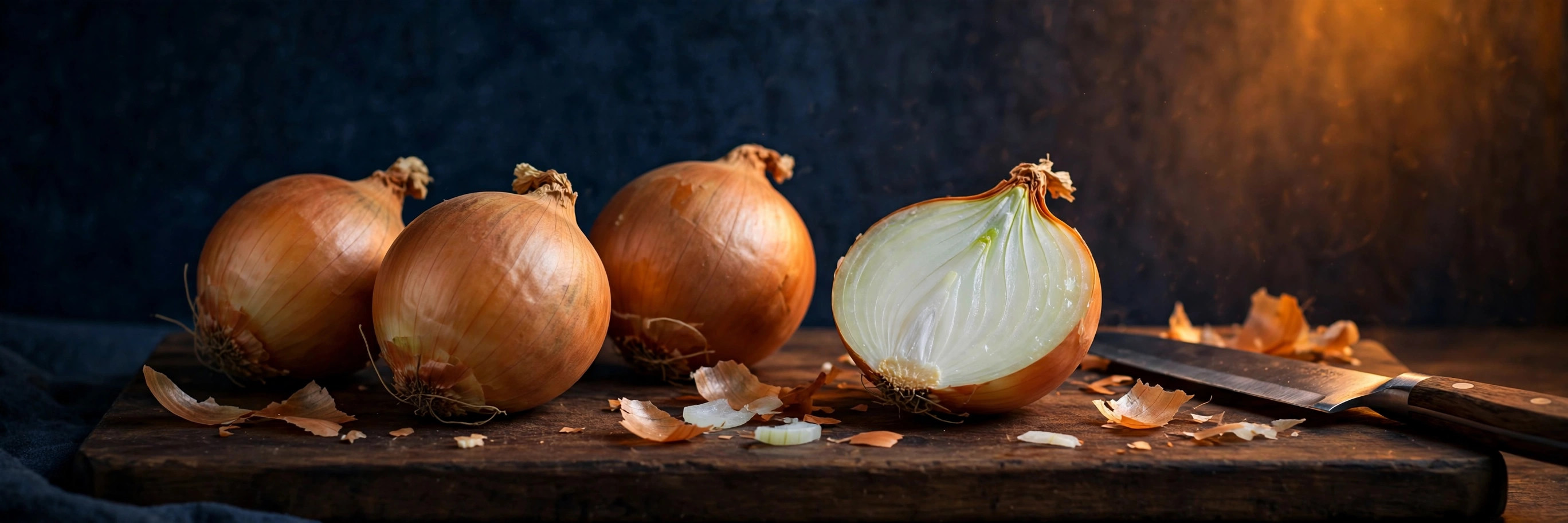
An intact onion is harmless. Slice it, and within seconds your eyes sting and water. That reaction is a defence system — the onion's, not yours.
Why do onions make you cry, even when you are perfectly happy? An intact onion does nothing to your eyes. The trouble starts the moment a knife breaks its cells open and lets chemicals that were kept apart finally mix. What follows is a short chain reaction that ends in a gas, and that gas ends at your eyes.
Those tears are not emotional. They are reflex tears, produced to wash an irritant away as quickly as possible.
Why do onions make you cry? A defence built underground
Onions grow underground, where hungry insects and animals would happily eat them. As they grow, they absorb sulphur from the soil and store sulphur compounds inside their cells. It is a useful defence: damage the plant, and you trigger its chemistry.
When you cut an onion, enzymes are released and convert those sulphur compounds first into sulfenic acid. A second enzyme, called lachrymatory-factor synthase, then rearranges that unstable acid into a volatile gas: syn-propanethial-S-oxide. Scientists once blamed a different enzyme for the whole process; work in Japan in 2002 identified lachrymatory-factor synthase as the key step, a finding summarised by the Library of Congress.
Being volatile, the gas drifts upwards from the board. When it reaches your eyes, it irritates the nerves in the cornea and stimulates the lachrymal glands. Your brain orders tears, and the tears dilute and flush the irritant away.
Do all onions do it equally?
No. White, yellow and red onions tend to have more of the compounds and enzymes needed to make the gas. Sweet onions, green onions and scallions generally produce less, so they are usually gentler — though growing conditions and freshness matter too.
You can reduce the effect without special equipment. Chill the onion first to slow the reactions, use a sharp knife so you crush fewer cells, and cut near a fan or an open window so the gas is carried away from your face. Cutting under a gentle stream of water also helps, though it is not always practical. Sealed goggles are the most reliable option, because they stop the gas reaching your eyes at all.
If kitchen chemistry interests you, compare this with another everyday reaction: how lightning can be hotter than the surface of the Sun shows energy at the opposite extreme.
So next time you tear up over dinner prep, blame evolution. The onion is not trying to ruin your meal — it is using a defence it built long before it ever met a chopping board.
Questions, answered
Do all onions do it equally?
No. White, yellow and red onions tend to have more of the compounds and enzymes needed to make the gas. Sweet onions, green onions and scallions generally produce less, so they are usually gentler — though growing conditions and freshness matter too.
More mind-blowing facts
 Science
What Was the First Webcam? The Coffee Pot That Started It All
The first webcam was not built for fame or fortune. It was built so a handful of Cambridge researchers would stop climbing stairs for an empty coffee pot.
 Science
Why Do We See Lightning Before Thunder? Light Is Nearly a Million Times Faster Than Sound
Why do we see lightning before thunder? Both are born in the same instant — the flash is the discharge, the thunder is the air it superheats exploding outward. Light simply arrives first, by a huge margin.
 Science
How Do Airplanes Fly? The Real Science of Lift
Airplanes fly because their wings push air downward — and the air pushes back up. That reaction force, plus lower pressure above the wing, is lift.