How Do Airplanes Fly? The Real Science of Lift
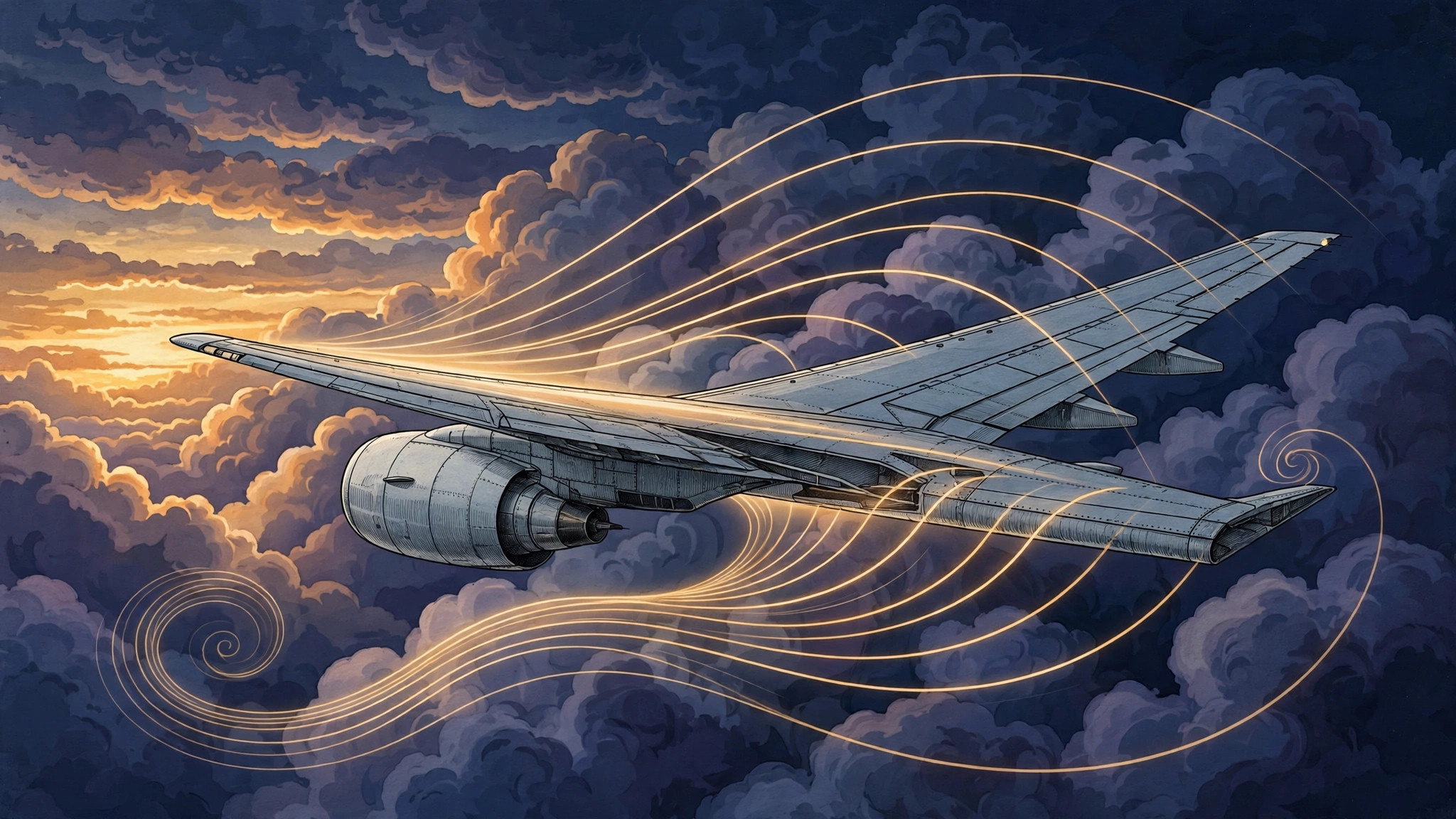
Airplanes fly because their wings push air downward — and the air pushes back up. That reaction force, plus lower pressure above the wing, is lift.
How do airplanes fly? The short answer is lift — and lift is mostly a push. A wing is shaped and angled so that as it moves through the air, it deflects the airflow downward. Newton's third law says every action has an equal and opposite reaction: push the air down, and the air pushes the wing up. That upward push, spread across the whole wing, is strong enough to hold a 400-tonne airliner in the sky.
The wing's shape matters. Most wings are cambered — curved more on top than underneath — and tilted slightly upward at the front, an angle pilots call the angle of attack. Air flowing over the curved top surface follows the bend and is guided downward, a tendency of fluids to hug a curved surface known as the Coandă effect. Air below the wing is also deflected downward. The combined downward flow is called downwash, and the reaction to it is lift.
How do airplanes fly if the classic explanation is wrong?
The explanation most of us learned at school — that air above the wing must speed up to cover the longer curved path and "meet" the air below at the same time — is a myth. Air above the wing really does move faster, and far faster than the "equal transit time" story requires, but there is no rule that the two streams must arrive together. The speed difference is a result of the flow bending around the wing, not its cause.
Bernoulli's principle still plays a real part: faster-moving air exerts lower pressure, so the air above the wing is at lower pressure than the air below it. At typical cruising speeds the pressure drop above the wing is only around five percent, while the increase below is about one percent — but multiplied by the huge area of a wing, that difference is an enormous upward force. Bernoulli and Newton are two descriptions of the same event, not rivals: the pressure difference and the downward deflection of air are two sides of one flow.
Speed is what makes it all work. A wing only generates enough lift once air is moving over it fast enough — which is why planes race down the runway before lifting off, and why pilots extend flaps on takeoff and landing to increase the wing's curve and area at lower speeds. Too slow, or tilted too steeply, and the smooth flow breaks away: that is a stall, and the lift collapses.
Why do airplanes fly so high?
Cruising altitude, typically 10 to 12 kilometres up, is a trade-off. The air up there is thin, so drag is lower and fuel goes further — but thin air also means less lift, which is why jets fly fast, around 900 kilometres per hour. It is the same thin, cold air that makes the sky blue and turns engine exhaust into white contrails behind the wing.
Questions, answered
How do airplanes fly if the classic explanation is wrong?
The explanation most of us learned at school — that air above the wing must speed up to cover the longer curved path and "meet" the air below at the same time — is a myth. Air above the wing really does move faster, and far faster than the "equal transit time" story requires, but there is no rule that the two streams must arrive together.
Why do airplanes fly so high?
Cruising altitude, typically 10 to 12 kilometres up, is a trade-off. The air up there is thin, so drag is lower and fuel goes further — but thin air also means less lift, which is why jets fly fast, around 900 kilometres per hour. It is the same thin, cold air that makes the sky blue and turns engine exhaust into white contrails behind the wing.
More mind-blowing facts
 Science
What Was the First Webcam? The Coffee Pot That Started It All
The first webcam was not built for fame or fortune. It was built so a handful of Cambridge researchers would stop climbing stairs for an empty coffee pot.
 Science
Why Do We See Lightning Before Thunder? Light Is Nearly a Million Times Faster Than Sound
Why do we see lightning before thunder? Both are born in the same instant — the flash is the discharge, the thunder is the air it superheats exploding outward. Light simply arrives first, by a huge margin.
 Science
Why Do We Have Seasons? The Tilt That Changes Everything
We have seasons because Earth leans 23.5 degrees on its axis — so each hemisphere takes turns leaning toward the Sun and away from it as the year goes by.