How Do Bees Make Honey? From Flower Nectar to Golden Jar
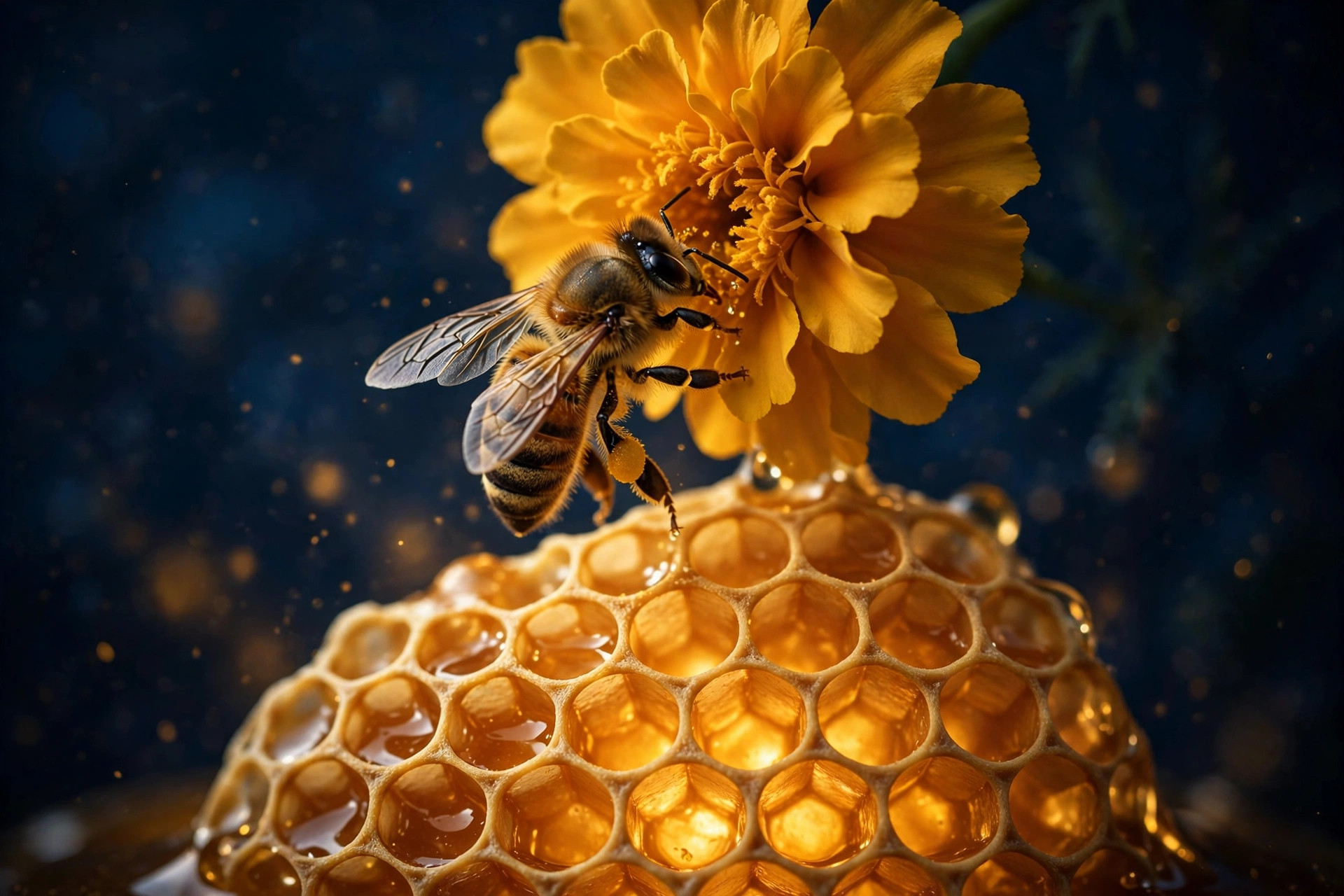
Bees make honey by collecting flower nectar, breaking down its sugars with enzymes, and fanning away most of its water until the thick golden result can be sealed in wax.
How do bees make honey? They turn flower nectar into honey in five careful steps: collect it, add enzymes, pass it from bee to bee, dry it out, and seal it in wax. It is not simply nectar stored in a jar — it is nectar chemically transformed and dehydrated by thousands of workers, a process that takes several days from flower to capped honeycomb.
It starts with the foragers. A worker bee visits 50 to 100 flowers on a single trip, drinking nectar through her long, straw-like tongue, the proboscis. She stores it in a special honey stomach — the crop — which is separate from her digestive stomach, so the nectar is carried, not eaten. Even on the flight home, the transformation has begun: an enzyme called invertase, added in the honey stomach, starts splitting the nectar's main sugar, sucrose, into two simpler sugars, glucose and fructose.
How do bees make honey inside the hive? Teamwork and evaporation
Back at the hive, the forager passes her load mouth-to-mouth to a house bee — a transfer called trophallaxis. The house bee chews the nectar for 15 to 30 minutes, mixing in more invertase and another enzyme, glucose oxidase, which later helps keep honey free of microbes. The nectar is passed between workers several times, each round adding more enzymes and losing a little water, until it is finally deposited as thin droplets in the hexagonal wax cells of the honeycomb.
Then comes the drying. Fresh nectar is around 70 to 80% water, and honey that wet would ferment and spoil. Thousands of workers line up near the comb and fan their wings at roughly 200 beats per second, driving warm, moist air out of the hive and pulling drier air in. Over one to three days the water content falls to about 17 to 18% — thick, sticky and so sugary that almost nothing can grow in it. Only then do the bees seal each cell with a thin cap of fresh beeswax, secreted from glands on the workers' abdomens.
The result keeps almost forever. With so little available water, plus natural acidity and the hydrogen peroxide produced by glucose oxidase, honey resists spoiling for years — which is why archaeologists have found edible honey in ancient Egyptian tombs. The scale of the work is humbling: a single worker makes only about one-twelfth of a teaspoon of honey in her whole lifetime, and roughly two million flower visits go into a single pound of honey. Like how fireflies make their cold light, honey-making is a small insect running a precise chemical factory — one flower at a time.
More mind-blowing facts
 Animals
Why Do Dogs Tilt Their Heads? The Science Behind the Adorable Tilt
Why do dogs tilt their heads? They are tuning their ears to locate a sound, seeing past their own muzzle, and concentrating on words they recognise — a sign your dog is paying close attention.
 Animals
Do Goldfish Have a Three-Second Memory? The Myth Debunked
The three-second goldfish memory is one of the most repeated animal myths — and it is wrong. Goldfish can remember for weeks or months.
 Animals
Why Do Dogs Wag Their Tails? It Is Not Always Happiness
A wagging tail does not always mean a happy dog. It is a social signal, and the speed, height and direction of the wag all change what the dog is saying.