Why Do We Knock on Wood? The Origin Is Newer Than You Think

I have never been ill — touch wood.' The gesture feels ancient, but the documented evidence for knocking on wood goes back only to the 1800s.
Why do we knock on wood after boasting about good fortune? The habit is so automatic that it feels ancient. The surprising truth is that the evidence for it is not.
Why do we knock on wood? The popular theories
The story most people hear goes back to tree worship. Pre-Christian Europeans, especially the Celts, were said to believe that spirits and gods lived inside trees, and that the oak — sacred to thunder gods such as Thor — was especially powerful. On this telling, touching or knocking on a tree thanked the spirit, or stopped it overhearing your boast and spoiling your luck out of envy.
A second popular theory ties the custom to Christianity: because Christ was crucified on a wooden cross, touching wood became a small prayer for protection. A third points to the oak's habit of attracting lightning, which made it seem like the dwelling of a sky god.
All three stories are vivid, and all three are repeated everywhere. The problem is that folklorists can find almost no evidence for any of them as the origin of the modern habit.
What the evidence actually shows
The earliest documented trace of "touch wood" as a protective act comes not from a temple or a sacred grove, but from a playground. In 1805, a book of Cumberland dialect ballads mentions "tiggy touchwood", a chasing game in which a player was safe from being tagged while touching something wooden — a door, a fence, a tree.
Folklorists Jacqueline Simpson and Steve Roud argue that this game is almost certainly the origin of the modern superstition. The game's rule was protection: touch wood and you cannot be caught. Over the 19th century, the gesture detached from the game and entered everyday speech, first as British "touch wood" and then as the American "knock on wood". The editors of the Oxford Dictionary of English Folklore agree, finding no trace of the custom before the 19th century and dismissing the tree-spirit and cross theories as romantic inventions added later.
That does not make the habit meaningless. Variants around the world show the same protective logic: in Turkey, people knock twice on wood and tug an earlobe; in Italy, the equivalent is "tocca ferro" — touch iron.
Why we still do it
Psychologists call it the illusion of control: doing something, however small, feels better than doing nothing when luck is at stake. Saying a hopeful thing out loud makes the good fortune feel fragile, as if naming it might jinx it. A quick knock restores a sense of agency, even though no physical act can change probability.
So knocking on wood is not a survival from pagan religion. It is a 19th-century playground rule that grew up into a global habit — proof that superstitions do not need to be ancient to feel timeless. For more beliefs with unexpected histories, see why Friday the 13th is considered unlucky and why we say "bless you" when someone sneezes.
More mind-blowing facts
 History
What Was the First Speeding Ticket? 8 mph in 1896
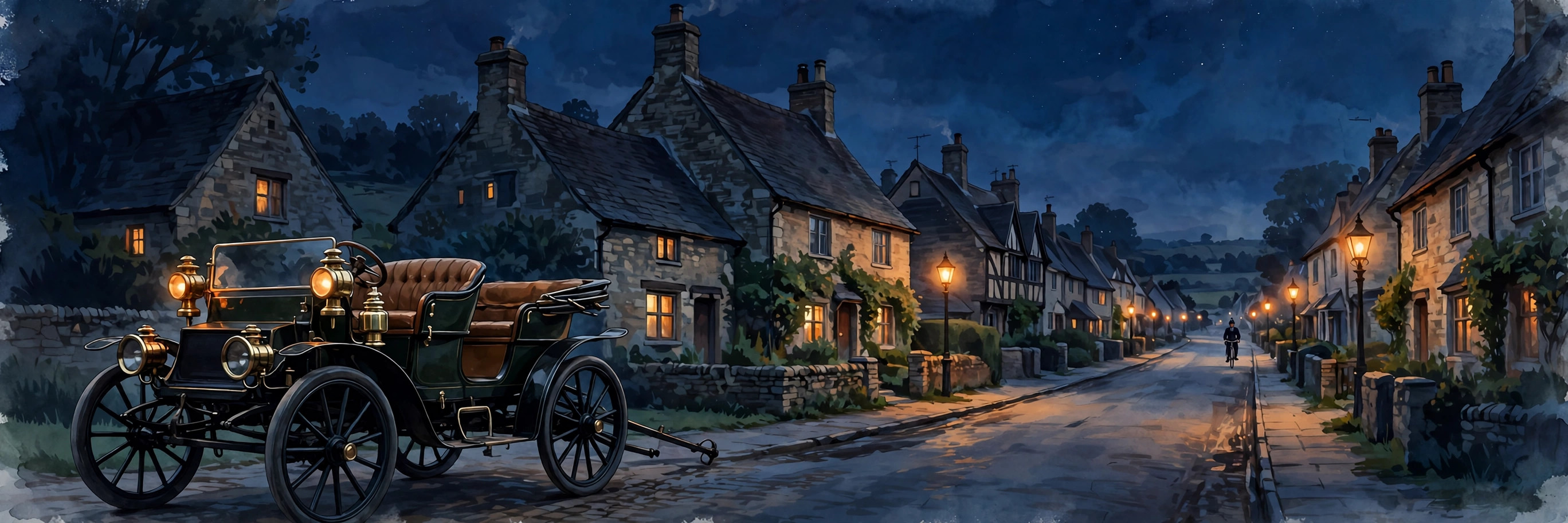
The first speeding ticket in history was issued for driving at 8 mph — four times the legal limit of 2 mph — and the officer who caught the driver was on a bicycle.
 History
Why Did Einstein Turn Down the Presidency of Israel?
In November 1952, Albert Einstein was offered the presidency of Israel. He declined within a day — and his reason was strikingly honest.
 History
Why Do We Say "Break a Leg"? The Theatre Superstition Explained
We say "break a leg" because theatre folk believe wishing a performer "good luck" will jinx the show — so they wish the opposite instead, hoping fate returns the favour.