What Is a Bobbit Worm? The 3-Metre Ambush Predator Under the Sand
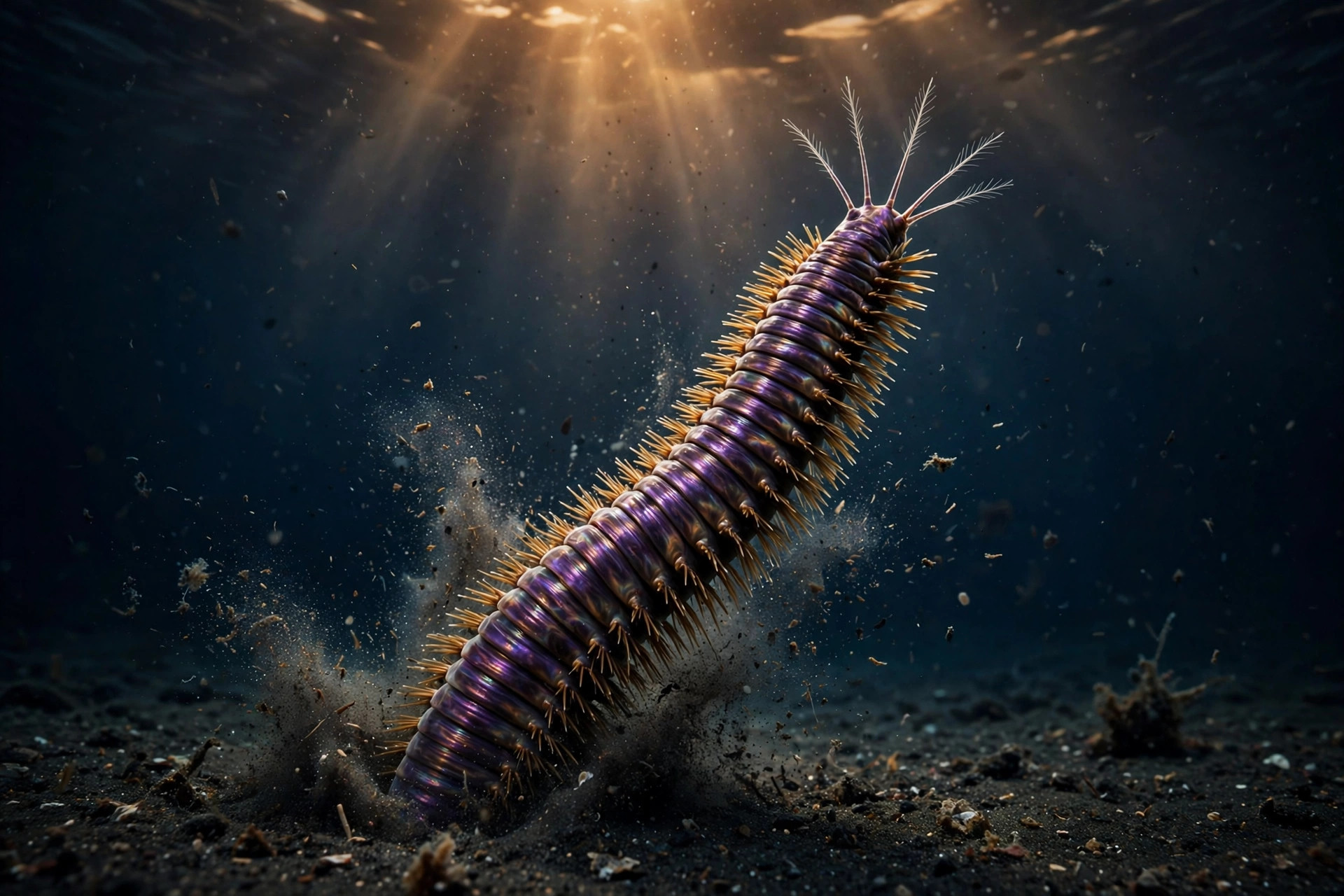
The bobbit worm is a giant bristle worm that hides in the seabed and ambushes passing fish with scissor-like jaws — the longest polychaete worm on record.
What is a bobbit worm? It is a giant predatory bristle worm, Eunice aphroditois, that spends its adult life buried in the sand of warm-water seabeds — and it is one of the most violent hunters in the ocean. You would almost never see one: all that shows above the sediment is a small head with five slender antennae and the tips of a pair of jaws. Below the surface can be up to three metres of segmented, iridescent body, waiting. When a fish swims within a few centimetres, the worm explodes upward, snaps its jaws shut, and drags its still-living prey underground. The whole sequence takes less time than a human blink.
The bobbit worm is the longest polychaete worm on record. Most adults are around a metre long, but the largest specimen ever measured reached 299 cm — nearly ten feet — and weighed 433 grams. It was found in 2009 inside one of the floats of a mooring raft in Seto Fishing Harbour, Japan, where it had been living for years. The worm had 673 body segments, each bearing bristle-like appendages, yet its body was only about 2.5 cm wide. It is slim enough to hunt in narrow cracks and crevices on coral reefs, and it has been recorded at depths of up to 95 metres across the warm Atlantic and Indo-Pacific, from the Red Sea to Japan.
What is a bobbit worm's hunting trick? Jaws that snap fish in half
The jaws are the defining feature. They sit inside a muscular, eversible pharynx — a throat the worm can turn inside out at speed. When the antennae detect vibration, chemical traces or a change in light above the sand, the worm thrusts its pharynx forward and the hard, toothed jaws clamp down like scissors, with enough force to cut a small fish in half. Some accounts report the jaws also inject venom that stuns larger prey. The victim is then pulled down into the worm's permanent, mucus-lined burrow to be eaten.
The name is the strangest part of the story. "Bobbit worm" is believed to come from the John and Lorena Bobbitt case of the early 1990s — a dark joke that stuck. Scientists prefer "sand striker" or "trap-jaw worm", and the species name Eunice aphroditois was published by the naturalist Peter Simon Pallas in 1788. The worm shot to fame in November 2017, when the BBC's Blue Planet II showed one erupting from the sand. Its hunting style is older than the fame, though: fossil burrows in Taiwan, described in a 2021 Scientific Reports study, show that worms like this were ambushing prey from beneath the seabed 20 million years ago. Like the mantis shrimp, another reef hunter with extraordinary weapons, the bobbit worm proves that the seabed's quietest residents can be its most dangerous.
More mind-blowing facts
 Food
Why Do We Eat Cranberry Sauce on Thanksgiving? From Bogs to Cans
Cranberry sauce reached the Thanksgiving table because the berry is native to North America, an 1796 cookbook paired it with turkey, and canning made it cheap and year-round.
 Mind
Why Do We Get Déjà Vu? The Brain Glitch Behind "Already Seen
Déjà vu is a brief mismatch between familiarity and memory — your brain flags a new scene as familiar, then catches the error a moment later.
 History
What Was the First Speeding Ticket? 8 mph in 1896
The first speeding ticket in history was issued for driving at 8 mph — four times the legal limit of 2 mph — and the officer who caught the driver was on a bicycle.